Last year when I wasn’t very well, I went through a spell of waking up at about 3am every morning and not being able to get back to sleep for a good couple of hours. My partner was so lovely and always told me to wake him up so he could keep me company when I was struggling to get back to sleep but I felt a bit selfish doing that when he still had to get up for work in the morning.
One thing I was really thankful for on those nights was the Simba mattress we’d got not long before. Not only was it super comfortable but it was also pretty much silent which meant I could toss and turn without disturbing him. Our old mattress not only made you feel like you were going to get stabbed by a spring at any given moment but it also squeaked every single time one of us turned over. Can you imagine how little sleep he’d have got if we’d still had that one? 😂
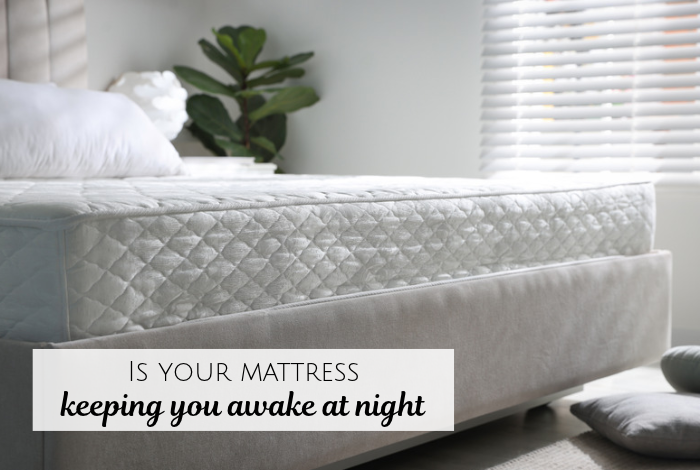
But what actually makes some mattresses noisier than others and how do you know whether it’s even your mattress that’s responsible for the noise? Before you spend money on a new one, there are a few things worth checking.
Why do traditional mattress springs squeak?
Traditional open-coil mattresses are made with springs that are connected to each other using metal wires. As the mattress gets older and starts to wear, the metal parts can rub against each other and cause that annoying squeaking noise.
Pocket springs are different because each spring sits inside its own little fabric pocket which allows it to move independently of the springs around it. This reduces the chances of the metal parts rubbing against each other and has the added benefit of meaning that you’re less likely to disturb the person sleeping next to you when you move around.
How do microsprings work in a hybrid mattress?
A hybrid mattress combines springs with other layers of material to give you both comfort and support. Some hybrid mattresses also have much smaller springs called microsprings which sit closer to the surface of the mattress and respond to your movements as you sleep.
If you have a look at Simba’s hybrid mattresses with responsive microsprings, you’ll see that they use something called Aerocoil® microsprings to help cushion your body as you change position during the night.
You’d be forgiven for thinking that the more springs a mattress has, the more chance there is of it squeaking but it’s actually more about how those springs are positioned and how they’re able to move within the mattress.
Check your bed frame
Before you even think about spending money on a new mattress, I’d start by checking your bed frame. There are quite a few things that could be causing the noise and some of them won’t cost you a penny to put right.
Check all the screws and bolts that you can easily get to as these can loosen over time. Wooden slats can also rub against the frame and metal bed frames can squeak where the different sections are joined together.
If you’re able to safely take the mattress off the bed then it’s worth gently testing the frame on its own to see if you can get it to make the same noise. If you can then you’ve potentially just saved yourself the cost of a new mattress!
Check the slats underneath your mattress
Whilst you’ve got the mattress off the bed, have a look at the condition of the slats underneath it. Check for any cracks and make sure they’re all sitting securely in the right place as even one loose slat could be responsible for the noise. If you’ve got a double bed or bigger then it’s also worth checking the central support that runs underneath the bed and making sure any supporting legs are secure.
The distance between your slats is important too as different mattress manufacturers have their own recommendations. Simba, for example, recommends a maximum gap of 7.5cm between slats for its mattresses. It’s something worth checking if you’re planning to buy a new mattress but want to keep your existing bed frame.
Is your bed sitting evenly on the floor?
This is something that’s worth checking if you live in an older house like ours where the floors aren’t necessarily as level as you’d like them to be. If one of the legs isn’t sitting properly on the floor then the whole bed frame can move slightly every time you turn over in bed.
Make sure all the legs are making contact with the floor and see whether moving the bed slightly makes a difference. If you’ve got wooden floorboards then it’s also worth checking whether it’s actually the floorboards themselves that are creaking rather than your bed.
Check your mattress guarantee
Modern pocket springs are designed to reduce noise but that doesn’t mean that a mattress can’t develop a fault over time. If you’ve ruled out everything else and you’re confident that the noise is coming from inside the mattress itself then I’d get in touch with the manufacturer.
It’s worth digging out your original order confirmation and checking how long your mattress guarantee lasts. Don’t assume that because you’ve had your mattress for a few years you’re automatically going to have to pay for a replacement as some mattresses come with surprisingly long guarantees. And definitely don’t be tempted to open up your mattress to investigate the springs yourself as you could invalidate any guarantee you have left.
A decent mattress isn’t cheap but having spent quite a lot of time awake in bed last year, I can definitely appreciate the difference a good one makes.
If you don’t want to miss future posts, you can add your email address to the subscribe box a bit further down this page and new posts will land straight in your inbox. You can also follow along over on my Facebook or on Pinterest for more money-saving ideas, recipes, family life and everything else I share on Frugal Family. And if you’re looking for some extra meal planning inspiration, you’ll find me over on my other blog, Meal Planning Made Easy, where I share simple meal plans, family-friendly recipes and plenty of ideas to make feeding everyone that little bit easier.
Do your future self a favour – Pin this post for later.
Discover more from The Diary of a Frugal Family
Subscribe to get the latest posts sent to your email.






Talk to me...