First up, I get that this is a post that’s probably only useful to you if you’re diabetic so please feel free to move on if you’re not diabetic 😁
But if you are and you’re struggling to understanding the difference between your HbA1c and your finger prick testing then this could be a pretty helpful post for you.
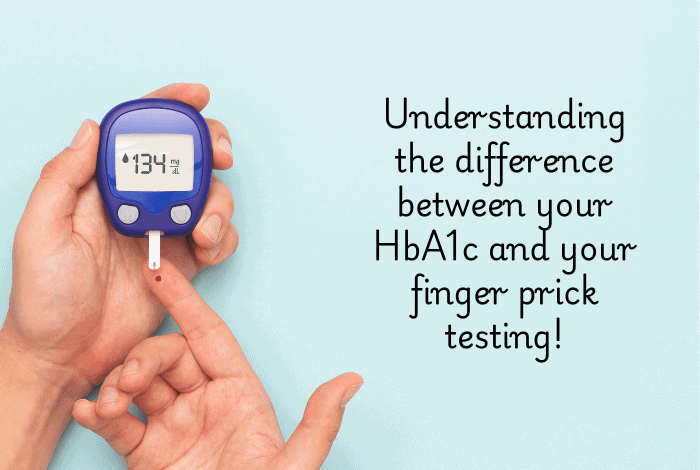
Understanding the difference between my HbA1c results and the blood glucose numbers from my daily finger-prick tests is something I really struggled to get my head around when I was first diagnosed and for some time afterwards.
It feels like there are so many numbers being thrown around that you need to get your head around as a newly diagnosed diabetic and between that and learning what foods I could and couldn’t eat, I found it really difficult to get the hang of.
I knew it was important to understand what each number meant and how I should use it to help me manage my Diabetes though so I ended up asking my Diabetic nurse to explain it to me like I was a six year old. 😁

The problem was that I was convinced that HbA1c and blood glucose were just two ways of saying the same thing.
It turns out they’re measuring completely different things, and once I understood that, everything else fell into place and I learned how to use each number to help me manage my diabetes.
I was told by my diabetic nurse when I was first diagnosed that it was a good idea to do finger prick tests to help me learn what foods ‘spiked’ my blood glucose levels so I could avoid them where possible. She didn’t really tell me what the numbers meant at first though but did say that there was lots of information available online so to get my laptop out and do some learning.
Lots of people don’t check their blood glucose levels and that’s completely up to them as I can see how easy it is to get hung up on the numbers – I follow the advice of my diabetic nurse and it’s helped me to learn what foods spike my blood glucose levels more than others so I know what to avoid or to at least eat less of. 😁
Blood Glucose vs HbA1c
Blood glucose is the number you get from a finger prick test, and it tells you what your blood sugar is doing at that exact moment. Because of that, it naturally moves around throughout the day depending on what you’ve eaten, whether you’ve just woken up, how active you’ve been, and even things like stress or illness. It’s not unusual to see different readings morning to evening, or before and after meals, and that’s completely normal.
HbA1c, on the other hand, is a blood test done by your doctor (usually every 3-6 months) and it looks at the bigger picture. Rather than focusing on one moment in time, it shows your average blood sugar levels over roughly the last two to three months. It’s usually measured in mmol/mol here in the UK, although you might sometimes see it shown as a percentage elsewhere. They’re the same measurement, just written differently.
This is where the confusion often comes in, because the two numbers don’t always seem to match up. You might have a really good finger prick reading on the day you test, but still be told your HbA1c is higher than expected. Or you might have the odd higher reading but still have a fairly steady HbA1c. That’s because one good or bad day doesn’t tell the whole story. HbA1c reflects the pattern over time, not a single moment.
A helpful way to think about it is that blood glucose is like checking the weather today, whereas HbA1c is more like looking at the climate over a few months. One tells you what’s happening right now, the other tells you what things have been like overall.
What is a normal finger prick reading?
This is usually the next question, because once you understand what the numbers mean, you want to know what you’re actually aiming for.
In the UK, blood glucose is measured in mmol/L, and for most people managing diabetes, the typical target ranges are around 4 to 7 mmol/L before meals and under about 8.5 to 9 mmol/L roughly two hours after eating.
When should you check your blood sugar?
This part can feel a bit overwhelming at first, but it doesn’t have to be complicated and the most important thing to remember and I’ll keep saying it, is that not everyone tests. Not everyone needs or wants to test – follow the guidance given by your medical team.
If you do test though…
Common times people check are first thing in the morning before eating or drinking, which gives you your fasting level and shows what your body has been doing overnight.
Checking before meals can help you understand your baseline, and checking about two hours after eating gives you a really useful insight into how your body responds to different foods.
Some people also like to check before bed to see where they’re ending the day but I don’t do that personally.
Why both numbers matter
Blood glucose and HbA1c work best together, rather than one replacing the other.
Finger prick checks help you make decisions in the moment and understand how your body reacts day to day, while HbA1c helps you and your healthcare team see what’s been happening over a longer period of time and whether anything needs to change.
I do like to get my head around how the two numbers link together, so I’ve got a chart on the inside of one of our kitchen cupboards that shows how a finger prick reading might translate into an HbA1c. It’s not something you need to overthink, but I find it helpful for seeing the bigger picture.
Understanding the link between the two numbers has really helped me to understand how I’m doing in my Diabetic journey.

Discover more from The Diary of a Frugal Family
Subscribe to get the latest posts sent to your email.