I absolutely love living in an old house. I love the character, the high ceilings, the big rooms, the wonky little details and the fact that every single corner seems to have a story attached to it.
What I do not love quite as much is the fact that every single corner also seems to have a job attached to it.
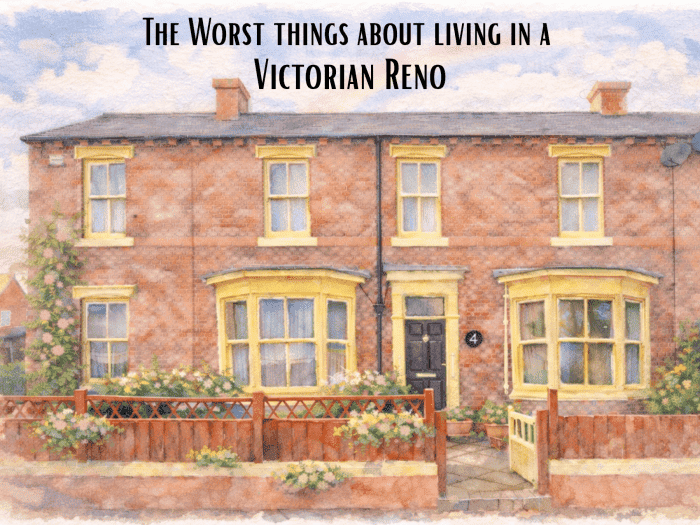
Living in a Victorian reno project sounds very romantic when you say it quickly. It sounds like you spend your weekends wandering around salvage yards, drinking coffee in a sunny bay window and casually choosing between Farrow and Ball colours with names that sound like Victorian illnesses.
The reality is slightly less dreamy. It’s more dust, draughts, mystery pipes and saying, “we’ll just live with that for now” about seventeen times a day.
So, in the interests of balance, here are the worst things about living in a Victorian reno project.
Nothing is ever just one job
In a normal house, you might say, “let’s paint that wall” and then you paint the wall.
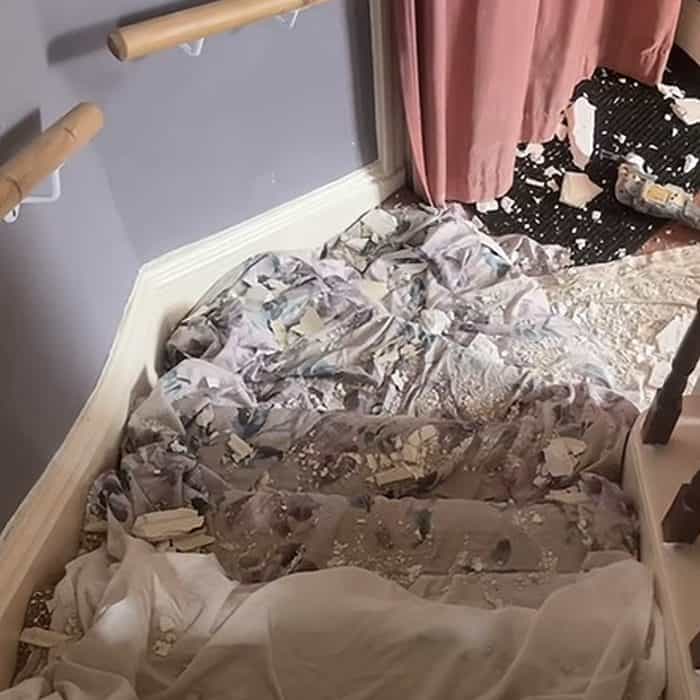
In a Victorian reno project, you say, “let’s paint that wall” and three hours later you are stood in a pile of plaster dust, googling whether that crack looks structural and wondering if you now need a plasterer, a joiner, an electrician and possibly a historian.
Every little job has a domino effect. You can’t just change a light fitting because the ceiling rose might crumble. You can’t just take up a carpet because there might be a floorboard situation underneath. You can’t just fill a hole because the hole has somehow become part of the house’s personality.
It’s like the house hears you making plans and immediately decides to humble you.
You develop a very close relationship with your plasterer
I used to think having someone on speed dial was reserved for your best friend, your other half or possibly the takeaway shop at the end of the road.
Now it’s the plasterer.
That probably tells you everything you need to know about living in an old house. There is always a wall that needs sorting, a ceiling that looks suspicious, a patch that has blown, a crack that needs looking at or a bit of plaster that has decided it no longer wants to be attached to the house.
At this point, I’m less “shall we get a plasterer?” and more “which wall has annoyed us enough to justify getting him back this time?”
The dust has moved in permanently
I used to think dusting was something you did every now and again when the sun shone through the window and made you feel ashamed of yourself.
Now I understand that dust is a lifestyle.
There is normal dust, and then there is old-house-renovation dust, which is a completely different beast. It appears from nowhere, settles everywhere and somehow gets inside cupboards, drawers, sealed boxes and probably your soul.
You clean one surface, turn around, and it is back again like it pays rent.
High ceilings are lovely until you have to buy things for them
Everyone loves high ceilings, don’t they? They’re one of those beautiful old-house features that make a room feel grand and airy and full of character.
They are also the reason a perfectly normal shower curtain suddenly becomes a special order.
In our bathroom, we couldn’t just buy a standard shower curtain because it would have looked like we’d accidentally hung a tea towel up. We needed one with so much extra length that it ended up costing about double what a normal one would have cost, which is not quite the romantic Victorian dream I had in mind.
We also wanted cladding rather than tiles on the bathroom walls, which sounded simple enough until we realised that because of the ceiling height, we needed boards that came in a longer length. That instantly ruled out about three quarters of the options, including, naturally, most of the ones I actually liked.
So yes, high ceilings are beautiful. But they also have very expensive opinions.
Every room has “potential”
This is both the best and worst thing about an old house.
Every room has so much potential, which is lovely, but also slightly exhausting because your brain never fully switches off. You can’t just sit in the dining room and have a cup of tea because you’re mentally changing the curtains, moving the furniture, stripping the fireplace, painting the skirting boards and wondering if the floorboards under the carpet are secretly beautiful.
You start off thinking, “this room could be amazing one day,” and end up staring into the middle distance calculating how many weekends, lottery wins and emotional support snacks it might take to get there.
Every decision feels weirdly high stakes
In a normal house, choosing a paint colour is probably just choosing a paint colour.
In a Victorian reno project, it becomes a full-on identity crisis.
I am so drawn to Farrow and Ball because this absolutely feels like a Farrow and Ball kind of house. It has the high ceilings, the big rooms, the old doors, the original features and the general air of a house that would very much like to be painted in something called Dead Salmon or Sulking Room Pink.
Unfortunately, while this may be a Farrow and Ball kind of house, we do not currently have a Farrow and Ball kind of budget.
So we do what I imagine lots of people do. We choose the beautiful colour, lovingly stare at the expensive paint chart for far too long, and then take ourselves off to the B&Q mixing desk to get a cheaper version mixed up instead.
It still feels like a decision every time though. Every colour has to work with the age of the house, the light in the room, the original features, the furniture we already have, the curtains I’ve probably found second-hand, and whatever slightly chaotic long-term vision is currently living rent free in my head.
Even the furniture becomes a full-on debate
It’s not just paint colours that become a big decision in a Victorian house. Furniture does too, because everything has to work extra hard not to look lost in the size of the rooms.
When we first moved in, we went for a giant cherry wood dining table because it felt like the sort of table the house deserved. The dining room is huge, so my partner was very much Team Big Grand Table, and to be fair, he had a point. A dainty little table would have looked ridiculous in there.
What followed were several very serious discussions about whether the table needed to be fully extended all the time, because fully extended it could easily seat 8-10 people and we absolutely do not need that on a day-to-day basis!
I’m not saying I lost that debate, but I did agree to the full extension on the very reasonable condition that I could choose any curtains I wanted (the only way I could get William Morris patterns in the house past my partner 😁).
House renovation is all about compromise apparently.
The problem was that the table was almost too nice. It looked beautiful, but we sit at our dining table a lot and I don’t want to live in a museum. I don’t want to be worrying every time someone puts a cup down, opens a laptop, eats dinner or generally uses the table like an actual table.
So we eventually decided it wasn’t quite right for the way we live.
We’ve now got a table that doesn’t necessarily match the Victorian vibe of the house in quite the same way, but it does match us. It suits how we use the room, it feels more relaxed, and I’m much happier with something that can cope with everyday life rather than something I feel like I should be guarding with a velvet rope.
Naturally, because my partner chose this one too, it is somehow even longer than the first one. So the table may be less grand, but apparently the need for it to be absolutely enormous remains unchanged.
Original features are lovely until they need replacing
One of the things I love most about this house is that it still has so many original features. The doors, for example, are beautiful and I know they’ll look amazing once they’ve all had a good sand down and stain.
That is technically doable.
What I am choosing to ignore slightly is the fact that we have a lot of doors. A lot. This is not a quick “Sunday afternoon with a cup of tea and a bit of sandpaper” job. This is a “see you in 2029” sort of job.
The original door knobs also need replacing, and because it’s an old house, we obviously don’t want to just shove any old modern ones on. We want something that looks right and feels in keeping with the house.
Which is lovely in theory.
In practice, the ones we found at a salvage yard were £45 each.
Each.
At that point, you start wondering whether a door really needs a knob after all, or whether we could all just politely push them open and embrace the rustic lifestyle.
You develop a weird relationship with previous owners
I don’t know if this happens to everyone, but you do find yourself talking about previous owners as if they are still in the house making choices.
“Why would they do that?”
“What were they thinking?”
“Who paints over that?”
“Why is this here?”
“Why has this been attached with what appears to be hope and one rusty screw?”
We definitely have a relationship with the previous owner of our house, even though we never really knew him. He lived here for many years and brought up his family here, so every little quirk feels like it has a story behind it. Some of those stories are lovely, and some of them are the sort of stories that involve us standing in silence, looking at each other and wondering how much it’s going to cost to fix.
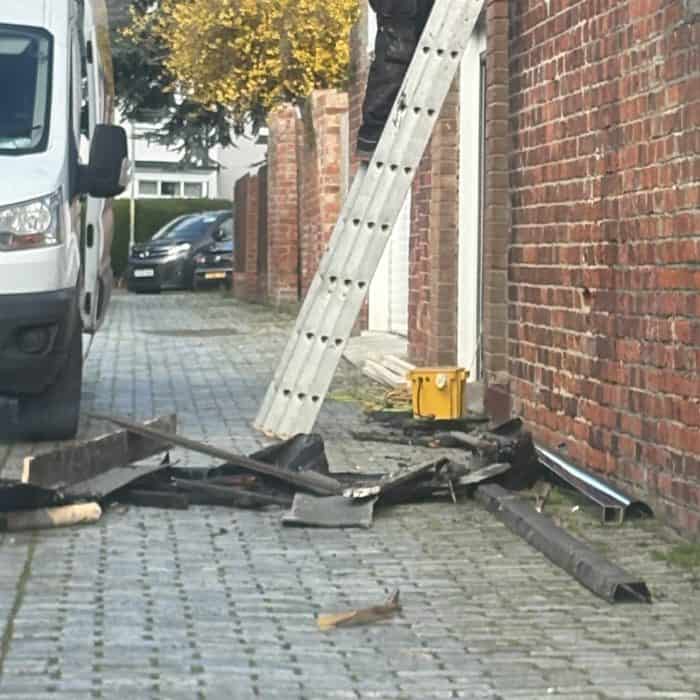
A perfect example is the utility room roof, which turned out to have a door and a fence panel up there rather than an actual roof frame. I’m still not entirely sure how to process that information, but I do know it meant we had to get roofers in within the first couple of weeks of living here, which was not exactly the gentle settling-in period I’d imagined.
Then there are the carpets over the original floorboards, which we do want to restore one day. I love the idea of bringing them back to life, but I wish so much that the previous owner hadn’t stained them a deep brown-red colour, heavy on the red, because getting that off is going to be an absolute nightmare. There is character, and then there is “why is the floor the colour of old mahogany furniture polish?” character.
But it’s not all questionable DIY and future sanding trauma.
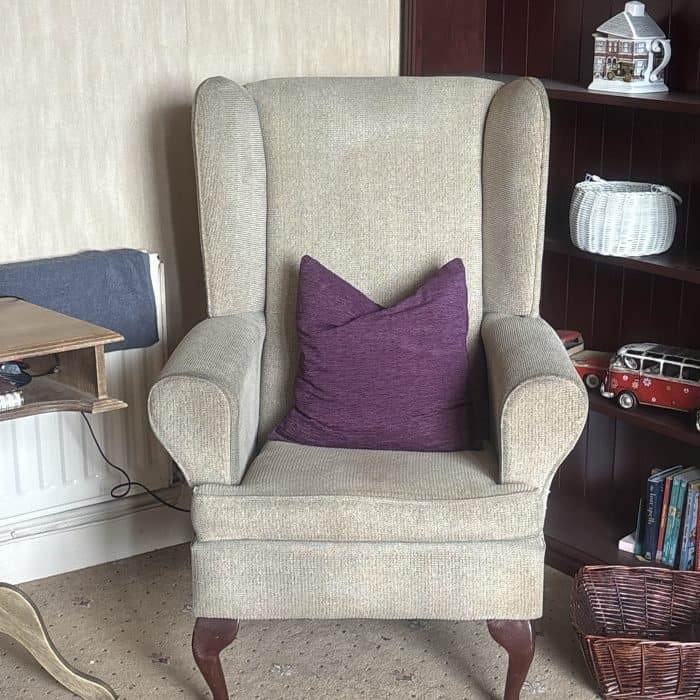
The previous owner’s daughters left us a chair that their dad used to sit in, and we’ve kept it. We all call it Tom’s Chair now. It’s had a good clean and it sits in the corner of our dining room, where I often sit and just relax for a bit.
It is impossible to finish one area before noticing another one
You might have a lovely productive day where you tidy one corner, move a piece of furniture, add a lamp and think, “yes, this is starting to feel like home.”
Then you step back to admire it and notice the cracked paint, the dodgy bit of skirting, the radiator that needs painting, the weird wire in the corner and the fact that the ceiling looks like it has been through a lot.
It is very hard to enjoy the finished bit when the unfinished bits are standing behind it waving.
Everything costs more than you think it will
You can start a job with a very sensible budget and a calm little plan, and then the house laughs in Victorian.
There is always something extra. A tool you didn’t know you needed. A tradesperson you didn’t expect to call. A repair hiding behind another repair. A tiny “while we’re doing that, we may as well…” that somehow adds £300.
It makes second-hand finds feel even more satisfying though, because when the actual house is busy eating money, finding a bargain piece of furniture on Facebook Marketplace feels like a personal victory.
Everyone tells you Rome wasn’t built in a day
The number of people who tell us that “Rome wasn’t built in a day” when we talk about the amount of work still to do is honestly impressive.
And I know they mean well. I do.
It is one of those sensible, comforting things people say when they’re trying to remind you that big projects take time and you can’t do everything at once.
The problem is that when you’re actually living in the middle of the big project, surrounded by half-finished jobs, dust, tools, paint charts and a to-do list that seems to grow every time you look at it, it’s not always quite as soothing as people think it is.
Because no, Rome wasn’t built in a day.
But I’m pretty sure that Rome didn’t have carpets hiding red-brown floorboards, a utility roof made partly of a door, and a plasterer who probably recognises your number when it flashes up on his phone.
So yes, we know it takes time. We know we’ll get there bit by bit. We know we can’t do everything at once.
But sometimes you do still want to look around and say, “Lovely, but could Rome maybe hurry up a tiny bit?”
You spend a lot of time saying “eventually”
Eventually we’ll do the floors.
Eventually we’ll sort that cupboard.
Eventually we’ll decorate this room properly.
Eventually we’ll replace that.
Eventually we’ll get someone in to look at that thing we’re currently pretending not to notice.
“Eventually” becomes less of a word and more of a coping strategy.
You can’t un-see things once you’ve noticed them
There is a special kind of peace that comes from not noticing something.
Once you’ve noticed the wonky line, the peeling corner, the patchy paint or the bit where the wallpaper doesn’t quite meet, that peace is gone forever.
You can be having a perfectly nice evening and then your eyes will drift over to the thing and your brain will whisper, “remember me?”
Rude, honestly.
It makes you very boring in DIY and vintage shops
I used to be a normal person. Now I can spend a worrying amount of time looking at filler, paint samples, door handles, wood stain and light bulbs.
I have opinions about finishes. I know which shade of cream is too yellow. I can spot a nice bit of old wood at twenty paces and I can absolutely recognise a quality piece of furniture, even when it needs a bit of TLC.
This is who I am now.
But also… I wouldn’t swap it
For all the dust, the chaos, the unfinished corners and the endless list of things that need doing, there is something really special about slowly bringing an old house back to life.
It is frustrating and expensive and sometimes completely overwhelming, but it is also full of little moments where you can suddenly see what it could be.
A room starts to feel like ours. A second-hand find lands in exactly the right spot. A bit of old character peeks through. The light hits a corner beautifully and I remember why we fell for the house in the first place.
So yes, living in a Victorian reno project is not quite as romantic as it looks on Instagram.
But it is ours, dust and all.
I’d love you follow me on Twitter and it would be amazing to see you over on my Facebook page and on Instagram. If you’re interested, you can find out more about me here and while I’ve got your attention, if you’re wondering why some of my posts lately are a little bit less frugal then have a read of this post. 😉
Do your future self a favour – Pin this post for later.

Discover more from The Diary of a Frugal Family
Subscribe to get the latest posts sent to your email.